VLF trasmitter
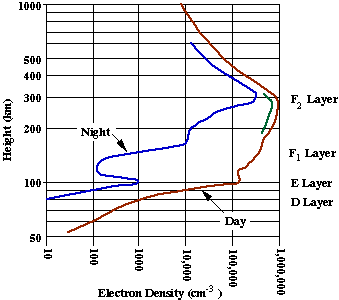
For our purpose, the D layer is of significant importance since solar flares and GRBs penetrate this ionospheric region. The monitoring the signal strength of a distant VLF transmitter allows to record SIDs related to solar flare or GRB events.
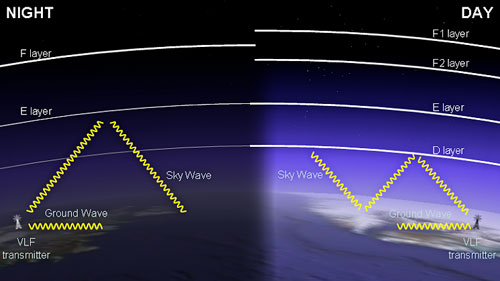
In the daytime, the VLF wavelenghts are so long that the radio waves are conducted in the Earth-ionosphere waveguide ( EIWG ) between the Earth's surface and the ionosphere D-layer. The propagation is very stable and the signal attenuation is low. Uncommon variations are used to observe the way the ionosphere has been affected by X-rays flares from the sun.
At night, the D-layer disappears and the waves are reflected by the higher E and F layers. The reflection coefficient is higher, thus leading to increased signal strengths at nighttime, but propagation is strongly affected by ionosphere characteristics, leading to significant signal variations that prevent monitoring SIDs.
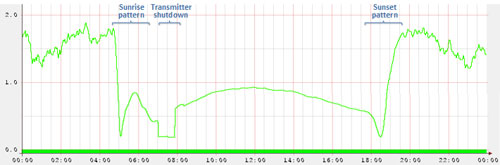
The sunrise and sunset patterns observed when recording signal strength correspond to the transition betwen the nighttime reflection of the signal at high altitudes and the daytime waveguide propagation mode.
A Sudden Ionospheric Disturbance results from an increased ionization density in the D layer caused by a solar flare or possibly by a GRB. During a solar flare, the sunlit side of the Earth is hit by hard X-rays and UV radiation. They will penetrate to the D-layer and increase the ionisation process and the electron density.
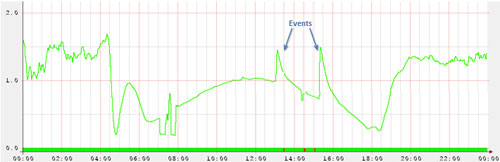
This will increase radio-wave absorption, especially in the upper MF (300kHz - 3 MHz) and lower HF (3MHz - 30 MHz) ranges, causing a radio blackout. For VLF (3 kHz - 30 kHz), the reflection coefficient increases, leading to a stronger skywave. Due to interferences between ground (direct propagation) and sky waves (reflected by the D-layer), the signal strength can increase or decrease during an event.
As soon as the event ends, the SID and radio black-out end as the electrons in the D-layer recombine and signal strengths return to normal.
The ionosation and recombination process are not instantaneous. Consequently, the disturbance will be detected with a slight delay with respect to the arrival of the X-ray photons (as measured by satellites such as GOES ) and will last after the end of the flare. A significant number of elements influence the amount of the lag: the intensity and the shape of the X-ray flux, the initial ionisation level... Nevertheless, the delay is usually between 1 and 5 minutes after the start of the flare. And the disturbance can last for an hour or more after the end of the flare.